
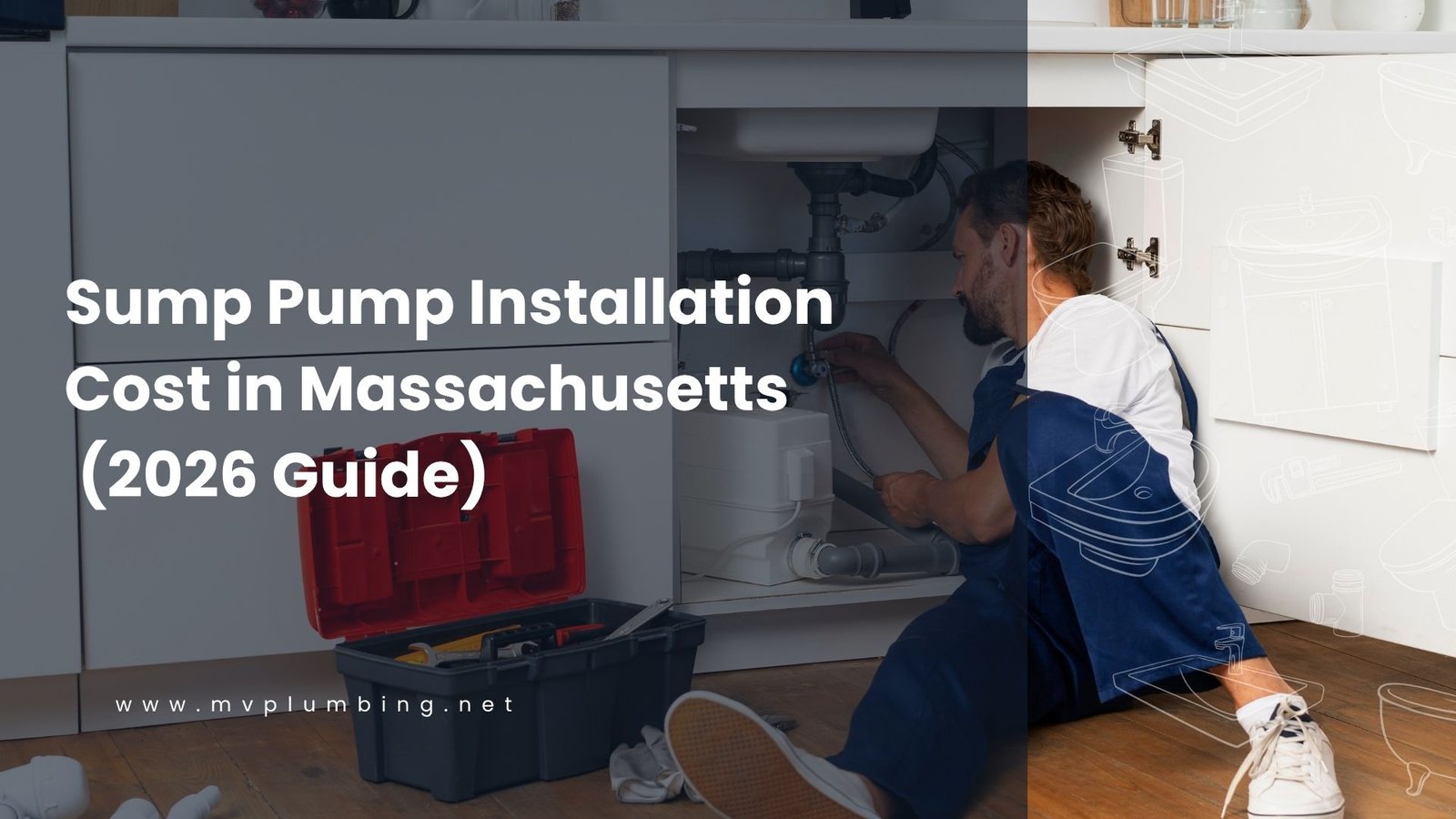
Sump Pump Installation Cost in Massachusetts (2026 Guide)
Every spring, thousands of Massachusetts homeowners discover their basement drains when it shouldn’t because their sump pump failed, was never installed, or was undersized for the job. Here’s what installation actually costs in 2026, what drives the price up, and how to avoid paying too much.
How Much Does Sump Pump Installation Cost in Massachusetts in 2026?
Sump pump installation in Massachusetts costs between $800 and $2,500, with most homeowners paying around $1,200–$1,600 for a standard submersible pump installed by a licensed plumber. Emergency or after-hours installs common in April flooding season add $150–$400 to the base rate.
These numbers reflect real 2026 South Shore and Greater Boston market rates not national averages. The final price depends on four main variables: pump type, whether a pit needs to be dug, discharge line complexity, and whether you add a battery backup. Let’s break each one down.
What Factors Drive Up the Cost of Sump Pump Installation in MA?
The biggest cost drivers in Massachusetts are: pit excavation (adds $400–$900 if no pit exists), soil conditions (clay-heavy soils in towns like Brockton and Stoughton require deeper pits), discharge line routing (exterior routing through older foundation adds $200–$350), and labor rates (Greater Boston area plumbers charge $125–$175/hour vs. $90–$130/hour in Taunton or Fall River).
Pump Type: Submersible vs. Pedestal
Submersible pumps sit inside the pit and handle more water volume they’re the standard choice for Massachusetts basements. Pedestal pumps have the motor above the pit and cost $100–$200 less upfront, but they’re louder and less effective in high-water-table situations common in South Shore towns near the Taunton River basin.
| Pump Type | Unit Cost (MA) | Labor | Lifespan | Best For |
|---|---|---|---|---|
| Submersible (plastic) | $150–$400 | $400–$700 | 10–15 years | Standard basements |
| Submersible (cast iron) | $250–$600 | $400–$700 | 20–30 years | High-volume, frequent use |
| Pedestal | $100–$300 | $300–$500 | 25–30 years | Narrow pits, crawl spaces |
| Water-powered backup | $200–$400 | $200–$400 | N/A (no motor) | Power-outage protection |
| Battery backup system | $300–$600 | $150–$250 | 3–5 yrs (battery) | Recommended MA |
Why Battery Backup Is Non-Negotiable in Massachusetts
Massachusetts averages 43–48 inches of precipitation annually, with a significant portion falling as spring rain and snowmelt between March and May (MA Executive Office of Energy & Environmental Affairs). During Nor’easters and spring storms, power outages hit exactly when your pump works hardest. A battery backup runs your pump for 5–7 hours during an outage enough to get through most storm blackouts.
Sump Pump Installation Cost by Massachusetts City (2026)
Labor rates vary meaningfully across the state. Here’s what you should realistically expect to pay based on your location:
| City / Town | Avg. Install Cost | Labor Rate/Hr | Key Notes |
|---|---|---|---|
| Boston / South Boston | $1,400–$2,200 | $140–$175 | High demand; older brownstones need custom routing |
| Quincy | $1,200–$1,800 | $120–$155 | High water table near shore; pit depth critical |
| Milton | $1,200–$1,700 | $120–$150 | Hillside homes; discharge routing can be complex |
| Randolph / Holbrook | $1,000–$1,500 | $110–$140 | Clay soil = deeper pits; adds $200–$400 |
| Brockton / Avon | $950–$1,400 | $100–$135 | High-volume market; competitive pricing |
| Stoughton / Bridgewater | $900–$1,350 | $100–$130 | Moderate water table; standard installs |
| Taunton / Fall River | $850–$1,250 | $90–$125 | Near river floodplain; high flood risk = high urgency |
| Somerset / Dorchester | $850–$1,300 | $90–$130 | Older homes; may need pit excavation |
How to Hire a Licensed Plumber for Sump Pump Installation in MA (Step-by-Step)
In Massachusetts, sump pump installation requires a licensed plumber either a Master Plumber or a Journeyman under supervision. Handymen and unlicensed contractors cannot legally perform this work. The Board of State Examiners of Plumbers and Gas Fitters enforces this, and violations can result in fines and voided permits.
- Verify the license before any conversation about price Check the contractor’s MA plumber license at the Mass.gov License Verification Portal. A licensed plumber will have a Master Plumber (MP) or Journeyman Plumber (JP) number. Ask for it upfront any hesitation is a red flag.
- Get 3 itemized quotes minimum Ask each contractor to break out: pump unit cost, labor, pit work (if needed), discharge line, permits, and cleanup. Bundled “one price” quotes make it impossible to spot overcharges.
- Confirm permits are included A proper sump pump install in Massachusetts requires a plumbing permit from your local building department. If a contractor says “we don’t need a permit,” walk away. Unpermitted work causes insurance claim rejections.
- Ask about discharge compliance Massachusetts stormwater regulations (under MGL Chapter 131) prohibit discharging sump water into the sanitary sewer system. Discharge must go to a dry well, daylight, or a compliant drainage point. Verify the contractor knows local code.
- Check BBB ratings and Google reviews Use BBB Massachusetts Plumber Directory to confirm there are no unresolved complaints. Sort Google reviews by “Newest” recent reviews reflect current service quality more accurately than 3-year-old praise.
- Confirm the warranty A quality install should carry a minimum 1-year labor warranty and whatever the pump manufacturer offers (typically 1–5 years depending on brand). Get it in writing before any deposit changes hands.
5 Red Flags When Hiring a Sump Pump Installer in Massachusetts
Based on real complaints surfaced in r/Plumbing and r/HomeImprovement, these are the most common mistakes Massachusetts homeowners report after bad installs:
- Contractor can’t provide a MA license number on request
- Quote doesn’t mention permits this is legally required in MA
- Offers to discharge into the municipal sewer line (illegal under MA stormwater rules)
- Asks for more than 30% upfront before work begins
- Installs a pump without checking the pit size against your home’s square footage and soil type
Should You Replace or Repair Your Sump Pump in Massachusetts?
If your sump pump is under 7 years old, repair is almost always the right call ($150–$400 for most issues). If it’s 10+ years old or has failed during a storm, replacement is the better investment especially entering Massachusetts’s spring flooding season when the next storm is weeks, not months, away.
| Scenario | Repair or Replace? | Typical Cost | Urgency |
|---|---|---|---|
| Pump won’t turn on, under 7 yrs | Repair (float switch) | $150–$250 | High fix this week |
| Pump runs continuously | Repair or Replace | $200–$500 | High indicates check valve failure |
| Pump is 10–15 years old | Replace | $800–$1,600 | Before next storm season |
| No backup + no pit | Full Install | $1,500–$2,500 | Critical in spring |
| Basement flooded during last storm | Replace + backup | $1,600–$2,200 | Emergency |
Common Mistakes Massachusetts Homeowners Make With Sump Pumps
After responding to hundreds of basement flooding calls across Quincy, Brockton, and the South Shore, these are the patterns that show up again and again:
1. Installing the Wrong Pump Horsepower
A 1/3 HP pump is sufficient for homes under 1,500 sq ft with moderate groundwater. Homes in Taunton or Somerset near the Taunton River floodplain, or any property with a high water table, need a 1/2 HP or 3/4 HP unit. An undersized pump runs constantly, burns out faster, and fails under heavy load exactly when you need it most.
2. Skipping the Backup System
Massachusetts sees 10–15 significant storms between March and November. Power outages during those storms are routine. A primary pump with no backup is a single point of failure. The $350–$700 investment in a battery backup system is the single highest-ROI addition to any sump pump install.
3. Illegal Discharge Routing
Plumbers without MA-specific knowledge sometimes route discharge lines into the sanitary sewer. This violates Massachusetts stormwater regulations and can result in fines from your municipality. Discharge must exit at grade level, to a dry well, or to a compliant daylight location at least 10 feet from the foundation.
4. Ignoring Pit Size
A pit that’s too small (under 18″ diameter) restricts pump operation and increases wear. Older Massachusetts homes especially in Dorchester and South Boston where basements were built pre-1960 often have inadequate original pits. A licensed plumber should assess and enlarge the pit as part of a proper install.
If you’re seeing water where you shouldn’t be, it’s worth reading our guide on 7 signs you have a hidden water leak some basement moisture isn’t a sump pump problem at all, but a pipe issue that requires different repair entirely.
Does Homeowner’s Insurance Cover Sump Pump Installation in MA?
Standard homeowner’s insurance in Massachusetts does not cover sump pump installation as a routine home improvement. However, if your pump failed during a covered storm event and caused water damage, the resulting damage may be covered but only if the pump was professionally installed with permits. Unpermitted installs typically void claims.
Some insurers offer a “water backup and sump overflow” rider for $50–$150/year that covers damage from sump pump failure. Given Massachusetts’s spring flooding risk, this is worth adding. The EPA’s WaterSense program notes that basement water damage is among the most common homeowner insurance claims in the Northeast region (EPA WaterSense).
Sump Pump FAQs Massachusetts Homeowners
How much does sump pump installation cost in Massachusetts?
Do I need a permit to install a sump pump in Massachusetts?
How long does sump pump installation take in MA?
What size sump pump do I need for my Massachusetts home?
Can a handyman install a sump pump in Massachusetts?
How often should a sump pump be replaced in Massachusetts?
Related MV Plumbing
We serve homeowners across the South Shore and Greater Brockton area. Find your local service page: Quincy, Brockton, Milton, Randolph, Taunton, Fall River, Dorchester, and South Boston.